
Published by Florida Dating Reset
A privacy-preserving verification sequence
- The first pass compares the person’s stated age range, location, work description, interests, and message details for a story that holds together over time.
- Look at the photos separately to see whether they appear to show one person and one life, with a consistent age, setting, and style.
- A verification badge or profile-completion feature adds context, though its meaning depends on the platform’s own description of the check.
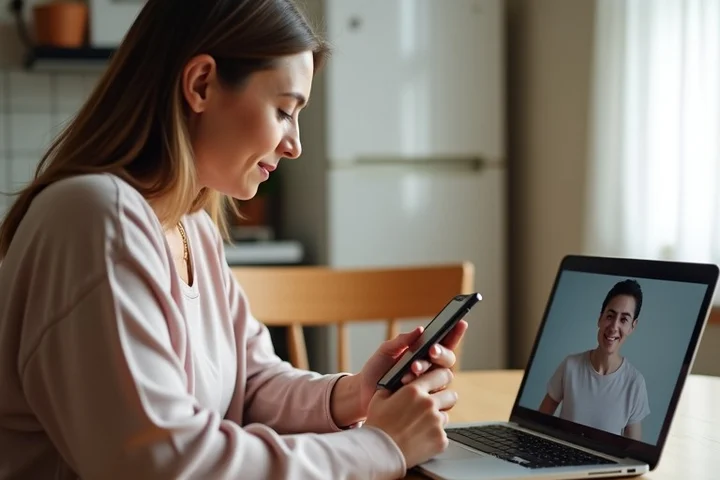
- When basic doubts remain, a short voice or video call through an in-app option, if available, offers a restrained final check without requiring a phone number, home address, or full name.
Reverse-image searches can reveal reused photos but cannot confirm identity
A reverse-image search might find the same photograph under another name, on a public account, in a stock-image collection, or in an older online post. That adds context, especially when the result sharply conflicts with the profile’s story. No result means only that the image was not found in places the tool indexed; it does not establish that the photo is original or current. Results can mislead when a real person’s public image has been copied, reposted, or mislabeled. Let the search add to or undermine the profile’s consistency, but never accept it as final proof of identity.
Verification badges provide a signal, not a background check
Put a badge alongside a completed profile or a responsive conversation: it adds one detail, not a verdict. Platforms use different processes and standards, so read the platform’s current explanation to learn what the mark represents.
It does not confirm someone’s criminal-record history, employment, legal identity, relationship status, or character. A badge can support a broader pattern of consistency, but ordinary judgment still matters.
When a short video or voice call resolves basic doubts
Text can present an unusually polished version of a person. A five-to-ten-minute call restores the ordinary details messaging leaves out: a face that matches the photos, a voice and manner consistent with the conversation, and a willingness to answer simple questions without evasion. If a dating service offers in-app voice or video, it keeps personal contact details private. Without that feature, sharing a phone number is still optional. A brief live interaction is a proportionate option, not a demand someone must meet.
Keep the call conversational. Skip requests for documents, social accounts, workplace access, or family information. A call only shows whether the person appearing live seems consistent with the profile and can sustain a normal exchange. It cannot confirm a legal name, job title, relationship history, or intentions. Someone may decline a call for privacy or comfort, and reluctance alone does not prove deception. Look instead at the larger pattern: clarity, respect for boundaries, and stable key profile details.
Which verification request is proportionate to the concern?
Low-level uncertainty, such as a sparse profile or an unclear interest, usually calls for more conversation and a simple clarification. A moderate concern, such as photos that do not seem to align with the stated background, can justify a reverse-image search or a short in-app call. Serious concern—repeated contradictions, pressure to move quickly, or resistance to every low-risk form of verification—does not require increasingly personal proof. Stepping back from contact is proportionate. Demands for identity documents, private social accounts, an exact employer, or information about children cross from sensible caution into intrusion.
Protect your personal data while confirming the match
Verification should reduce uncertainty, not create a new exposure. Do not share photographs of identity documents, financial information, account or login codes, a home address, or unnecessary workplace details to demonstrate that you are real. A match also has no need for a child’s school, schedule, or other identifying family information. Keeping early verification inside the dating app, when possible, limits how much personal data changes hands. Any process that depends on secrecy, financial disclosure, or credentials belongs outside the bounds of ordinary dating verification.
Good verification is modest by design. A profile that remains consistent, has photos that withstand a little scrutiny, and aligns with a brief live interaction may be worth getting to know further. None of those signals creates certainty, but together they offer a calmer and more private basis for deciding whether to continue.